
Mobile Rehab provides specialist home physiotherapy in Wokingham for individuals living with Parkinson’s disease and other progressive neurological conditions. Home-based rehabilitation is particularly effective for Parkinson’s disease as it enables movement retraining in the exact environment where mobility difficulties occur, such as turning in confined spaces, navigating furniture, and initiating movement from rest.
This case study outlines a structured Parkinson’s physiotherapy programme delivered entirely within the patient’s home in Wokingham.
Home Physiotherapy in Wokingham – Parkinson’s Disease Rehabilitation Case Study
Patient Background
A female patient in her mid-70s with a diagnosis of Parkinson’s disease was referred for private home physiotherapy in Wokingham due to progressive deterioration in mobility and functional independence.
The patient reported increasing difficulty with initiating movement, frequent episodes of freezing of gait, reduced walking speed, and a noticeable reduction in step length. These symptoms were becoming more pronounced within confined home spaces, particularly when turning, changing direction, or moving between rooms.
She was also experiencing reduced confidence with mobility, particularly when walking without support, and had begun relying more heavily on furniture and household objects for stability.
The primary rehabilitation goals were to improve mobility initiation, reduce freezing episodes, enhance balance control, and maintain independence within the home environment for as long as possible.

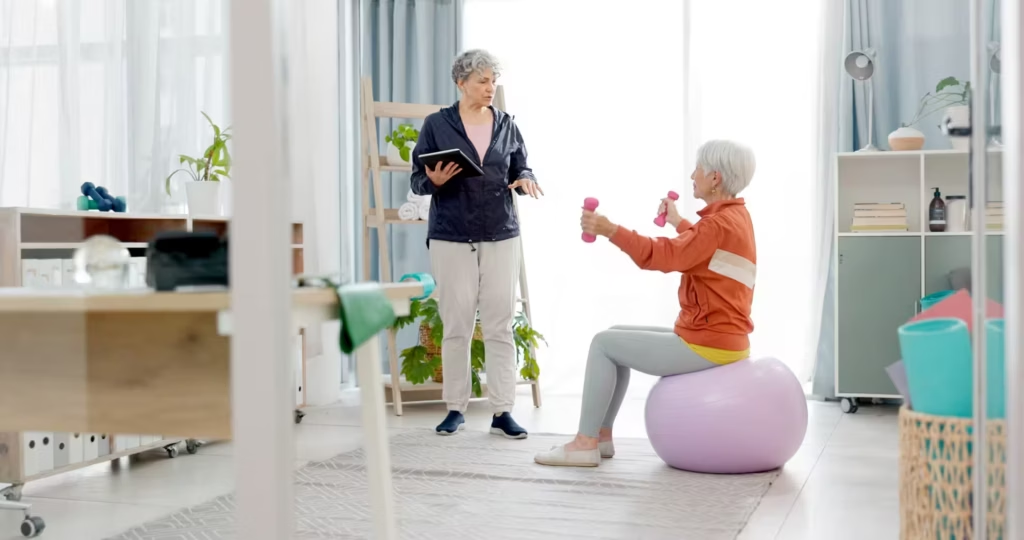
Initial Home Physiotherapy Assessment in Wokingham
A comprehensive neurological physiotherapy assessment was completed within the patient’s home in Wokingham to evaluate functional mobility in a real-world setting.
Assessment was carried out across key areas of the home including hallway navigation, kitchen movement, seating transitions, and turning within confined spaces.
On assessment, the patient demonstrated clear bradykinesia affecting both upper and lower limb movement, with significantly slowed initiation of voluntary movement. There was reduced amplitude of movement, particularly during walking, resulting in a shuffling gait pattern.
Freezing of gait episodes were frequently observed, particularly when turning, approaching doorways, or transitioning between different flooring surfaces. These episodes often resulted in hesitation, increased anxiety, and reliance on nearby objects for support.
Postural instability was also evident during static standing, with reduced ability to maintain balance during weight shifts or dual-task activities.
Treatment Plan – Home-Based Parkinson’s Physiotherapy Programme
A structured and progressive rehabilitation programme was delivered within the home environment, focusing on movement re-education, cueing strategies, and functional independence.

Gait Re-Education and Movement Initiation Training
A key focus of rehabilitation was improving movement initiation and reducing freezing episodes. External cueing strategies were introduced, including visual cues (floor markers and target stepping) and auditory cues to support rhythmic walking patterns.
These strategies were used to improve step initiation, increase step length, and reduce hesitation during movement transitions.
Repetition was prioritised to support motor learning and improve automaticity of movement over time.

Sit-to-Stand and Transfer Training
Sit-to-stand transfers were retrained with emphasis on forward weight shift, controlled momentum, and improved timing of movement initiation.
The patient practised repeated transfers from different seating surfaces within the home to improve adaptability and functional independence.
Attention was given to reducing freezing episodes during transitional movements, which were often triggered by hesitation or dual-task demands.

Balance and Turning Control
Balance retraining focused heavily on controlled turning movements, which were identified as a significant trigger for freezing episodes and instability.
Structured turning drills were introduced in both open and confined spaces, with emphasis on breaking down movement into smaller controlled steps.
Static balance training was also included to improve postural stability during standing tasks and reduce reliance on external support.

Functional Walking Practice in Real Home Environment
Walking practice was completed entirely within the home environment to ensure real-world relevance. This included walking through narrow hallways, doorways, and kitchen spaces where freezing episodes were most commonly reported.
Training was adapted to reflect real-life scenarios rather than structured clinical walking patterns, improving functional carryover.

Freezing of Gait Management Strategies
Specific strategies were introduced to manage freezing episodes, including “stop-reset-step” techniques, weight shift initiation strategies, and cue-based movement initiation.
The patient was also taught how to recognise early signs of freezing and apply corrective strategies before full movement block occurred.
Progress and Outcomes
Over the course of rehabilitation, the patient demonstrated measurable improvements in mobility and confidence.
Freezing episodes reduced in both frequency and severity, particularly during turning and transitional movements. Movement initiation became more consistent, with improved step length and reduced hesitation.
The patient demonstrated increased confidence when walking within the home and reduced reliance on furniture for support.
Overall independence with daily mobility tasks improved, allowing for safer and more efficient movement throughout the home.
Clinical Summary
This case demonstrates the effectiveness of home physiotherapy in Wokingham for Parkinson’s disease. Delivering rehabilitation within the patient’s real environment allowed targeted treatment of freezing triggers and movement difficulties in the exact situations where they occur.
Home-based Parkinson’s physiotherapy is particularly effective due to the importance of repetition, cueing strategies, and functional movement retraining in real-world environments.
Recognised Health Insurance Providers


Our Registrations


